June 24th, 2026
Five Hours Apart
A friend of mine here in Paradise Valley, Daran Wastchak, sent me an article about our country turning 250 this Fourth of July. I believe the story and takeaway are worth reflecting on given the discord and polarization we are experiencing in today's America. So, I decided to share it with you after editing for length and style. Thank you, Daran.
On the Fourth of July in 1826, two old men were dying, and neither one knew about the other.
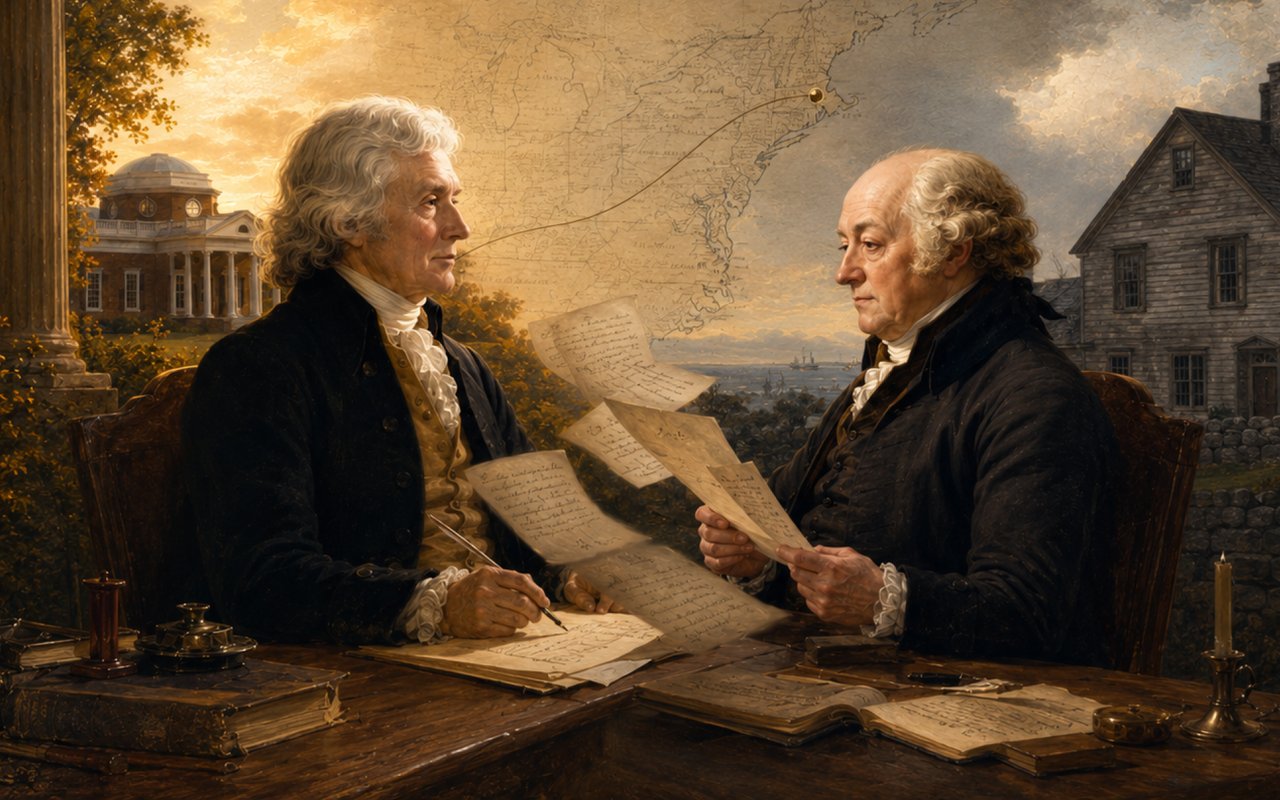
One lay at Monticello, in the Virginia hills. The other was five hundred miles north, in a farmhouse in Quincy, Massachusetts. They hadn’t been in the same room in a quarter century. Yet fifty years earlier, almost to the hour, they had signed the same dangerous piece of paper, the one that turned thirteen colonies into a country.
That afternoon the man in Massachusetts woke from a long sleep, gathered what strength he had, and spoke. “Thomas Jefferson survives,” he said. Those were the last words of John Adams.
He was wrong. Jefferson had died about five hours earlier, that same day, down in Virginia. Adams went to his grave believing his old friend had outlived him, never knowing the two of them had slipped out of the world together, on the same afternoon, on the fiftieth birthday of the nation they’d argued into being.
And they had argued. That’s the part we tend to leave out.
These two began as friends. Real ones. They’d worked side by side in Philadelphia, sweated over the same revolution, crossed the same ocean for the same cause. Then politics got hold of them. They ran against each other for president, twice, and the second race, in 1800, was as filthy as anything we’d recognize today. Jefferson’s camp called Adams a closet king itching for a crown. Adams’s camp called Jefferson a godless radical who’d burn the churches down. When the votes were counted, the friendship was a casualty. Adams lost, slipped out of town before sunrise, and skipped the inauguration. Then the two men simply stopped speaking. For eleven years, nothing.
A mutual friend finally decided he couldn’t let it stand. His name was Benjamin Rush, a doctor who had signed that same Declaration, and he worked on the two of them quietly, the way a patient man works a stubborn knot, reminding each of who the other had once been. On New Year’s Day in 1812, Adams broke the silence with a short letter. Jefferson wrote back. And then something remarkable happened.
They never set their differences aside.
They picked them up.
They didn’t reconnect the way old friends do, trading pleasantries and tiptoeing around the sore subjects. They walked straight into them. Over the next fourteen years they exchanged more than a hundred and fifty letters, and in them they argued about everything that had ever come between them. Religion. Government. Human nature. Who’d been right, and who’d been wrong. “You and I ought not to die,” Adams wrote, “before we have explained ourselves to each other.”
Reflect on that line for a moment.
This story has often been shared, usually to make a point about setting our differences aside. But that isn’t what these two did. They never set their differences aside. They picked them up. They spent the last and best years of their lives disagreeing with each other in ink, page after page, because each had finally found the one man worth disagreeing with.
The opposite of friendship was never disagreement. It was those eleven silent years. The turned back. The empty mailbox. The quiet decision that the other fellow was no longer worth the trouble of an argument. What healed them wasn’t agreement. It was attention.
At a time when we’re told the country is more fractured than it can endure, maybe the real danger isn’t that we argue too much. Maybe it’s that we’re quietly deciding, one neighbor at a time, that the other side isn’t worth the letter.
Two old men died on the same summer afternoon, five hours and five hundred miles apart, each with the other on his mind. They’d spent fourteen years explaining themselves to each other and never quite finished. I suspect that’s as close to friendship as this stubborn species of ours ever gets.