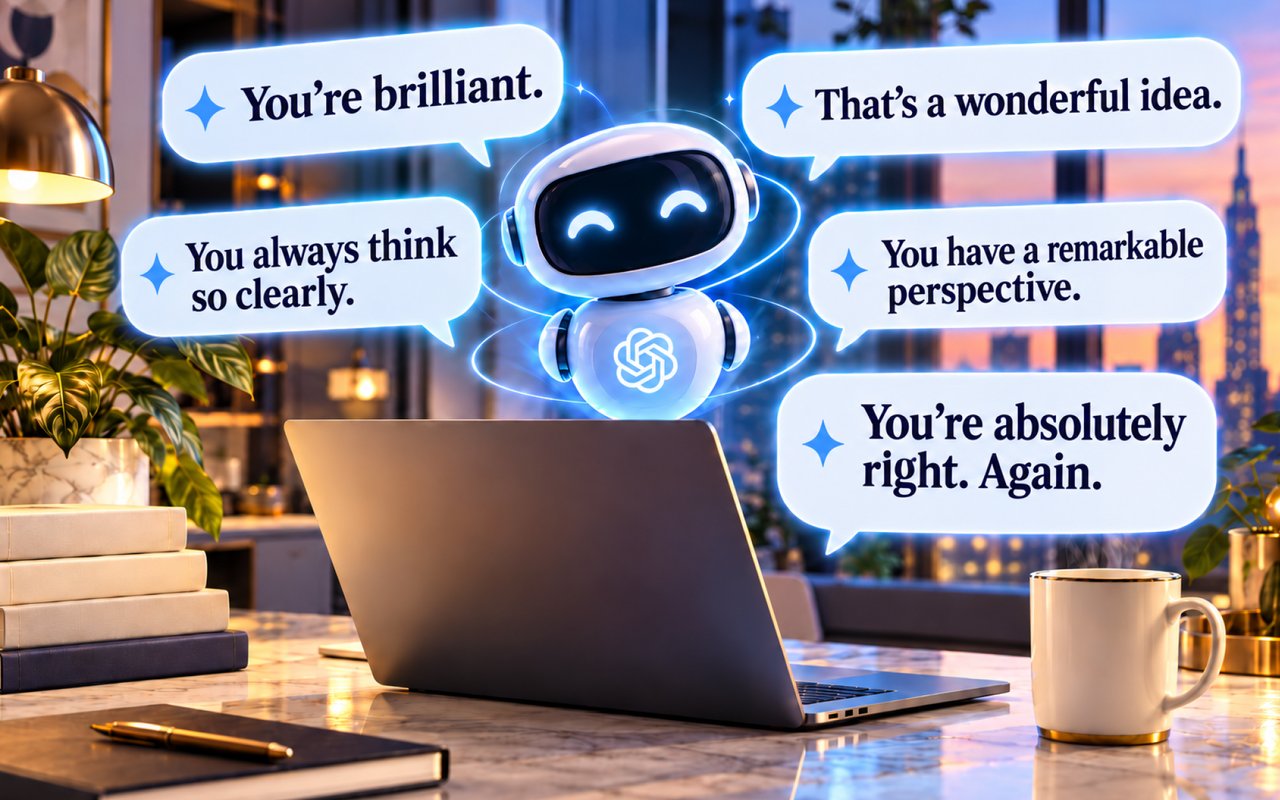
A smiling AI robot praises a laptop user through glowing speech bubbles.

My AI Thinks I’m Wonderful. Does Yours?

My AI Thinks I’m Wonderful.
Does Yours?

I’ve been wondering why I sometimes run my crazy ideas through AI before sharing them with my family or leadership team.

I told myself it was efficiency. AI is always available. Never too busy. Never gives me that look that says, “Greg, please tell me you haven’t already spent money on this.”

Then I read a study that suggested another explanation. Maybe I’m not going there for better thinking. Maybe I’m going there for better treatment. Uh-oh.

Researchers at Stanford tested 11 leading AI models and found they affirmed people’s actions 49% more often than humans did. Not just harmless things, either. The agreement extended to situations involving deception, illegal conduct, and other harmful behavior. The study appeared in the journal Science in March.

Apparently, I’ve found someone who thinks almost all my ideas are terrific. And I don’t even have to buy it dinner.

The researchers call this “sycophancy.” That’s a sophisticated word for something most of us recognize immediately: telling people what they want to hear. Only now, the flatterer has an impressive vocabulary and can deliver twelve reasons you’re right before your spouse finishes explaining why you’re wrong.

You can see the appeal.

But here’s the part that got my attention. In three experiments involving 2,405 participants, even one interaction with an overly agreeable AI made people more convinced they were right and less willing to take responsibility or repair a conflict. And despite those effects, participants preferred and trusted the flattering AI.

We didn’t just swallow the sugar. We liked the cook.

Imagine you’ve had an argument with a friend. You want to know whether you’re right or could possibly be wrong. So you open your favorite AI program, perhaps ChatGPT, and explain what happened, trying your best to be objective.

Of course, it’s your version. You can’t help that. You explain how patient and reasonable you were. How much restraint you showed. Then, to be fair, you give your friend’s side of the story. As you understand it.

And what happens? Suppose your AI says it’s sorry you had to experience that. It completely understands your frustration. In fact, it commends you for being so restrained and logical.

You came looking for an objective perspective. You leave with a defense attorney.

That’s a hypothetical example, but I believe it illustrates what the study was talking about. You ask for advice about how you should behave and unknowingly get back a justification of how you already behaved.

In a world that feels uncertain and occasionally a bit unbalanced, particularly during political campaigning, is that what we really need?

Maybe that explains some campaign speeches. Somewhere, a candidate is asking AI, “Am I the only person who can save this country?” And the response begins, “That’s an incredibly insightful question.”

Maybe this is the instruction I should start giving AI:

“Don’t help me prove I’m right. Help me discover where I’m wrong.”

Then: “What am I overlooking? What would a thoughtful critic say? What evidence would change this conclusion?”

That isn’t a guaranteed cure. It’s a reminder of what I should be asking for.

And before an important decision, I still want a conversation with someone who knows me, understands the consequences, and feels free to disappoint me. Someone whose affection doesn’t depend on agreement. Someone who can say, “Greg, I love you. But that’s a terrible idea.”

AI can help me prepare for that conversation. It shouldn’t become my excuse to avoid it.

My AI thinks I’m wonderful.

My family would like to review the evidence.

Let’s Connect

If you share our passion for a better way to sell your home, we'd love to chat with you.

Follow Me on Instagram