
March 17th, 2026
Washington State Just Passed a Discriminatory Housing Law. The Legislature Was Hoodwinked. Here's Why.
By Greg Hague, J.D., Licensed Attorney (Ohio and Arizona), Licensed Real Estate Broker (Kentucky and Arizona)
Let me tell you who I am before I tell you what I think, because what I think is going to upset some very powerful people.
I have been in the real estate business since the mid-1970s. I am a licensed attorney in two states and a licensed real estate broker in two states. I have personally trained thousands of agents, operated successful brokerages, and spent decades in the trenches helping families buy and sell homes. REALTOR Magazine, the official publication of the National Association of Realtors, ranked me the number one top-selling agent in my state and number 19 in the entire nation. I have seen every cycle, every trend, every scheme, and every power play this industry has produced in the last fifty years.
I also need to tell you something else, because what I am about to argue will inevitably be twisted by people who profit from the status quo. I am fiercely opposed to discrimination of any kind in housing. I don't just say that. I proved it.
In the 1970s, I was the attorney who helped convince Cincinnati real estate brokers not to fight, but to settle, the landmark racial steering lawsuit known as Brown v. Federle Realtors. At the time, agents were innocently but harmfully presuming that Jewish buyers would want to live in predominantly Jewish neighborhoods and that buyers of a specific race would prefer communities of predominantly that race. Nobody thought of it as discrimination. But it was. I took the lead in convincing those brokers that this practice had to end, that they needed to settle and educate their agents. If you look up the Brown v. Federle consent decree, I am the attorney who signed off on my father's firm's settlement. I did not wait for a court to force the right outcome. I pushed for it.
So when I tell you that Washington State's new Senate Bill 6091 is not about protecting consumers, not about fair housing, and not about preventing discrimination, I am telling you that from a position of someone who has fought those fights and won them. This law is about something else entirely.
And whether you are a professional who sells homes, or you own a home in Washington or anywhere else in America, what happens with this law could set a precedent that affects you in serious ways. What happens in Washington is already spreading as Wisconsin, Illinois, Hawaii, and Connecticut are considering identical legislation drafted by the same corporate interests.
What Actually Happened in Washington
Here is what the real estate industry's largest gatekeepers do not want you to think about too carefully: no group of homebuyers marched on the Washington State Capitol demanding this legislation. There was no consumer outcry. No evidence was presented that buyers were being systematically denied access to homes. No data showed that any demographic was being excluded from the market. None of that happened.
What did happen is that the MLS industry and massive home search portals like Zillow recognized a threat to their gatekeeper position. Brokerages like Compass had begun marketing certain listings on their own platforms, outside the traditional MLS pipeline. Howard Hanna recently launched HannaList, a strategic listing program designed to give sellers more control over how their homes enter the market. These innovations threatened the tollbooth model that the MLS system and portal websites depend on for revenue.
So the gatekeepers did what gatekeepers always do. They lobbied. And when the bill passed, Zillow published a corporate press release celebrating SB 6091 as "a win for Washington home buyers and sellers." A win for buyers and sellers? Or a win for Zillow's business model?
Washington's legislature, either not understanding or not caring about the consequences, handed them exactly what they wanted: a law that can be misinterpreted to funnel every home listing back through the very platforms that profit from controlling them.
Make no mistake. This legislation was not born from consumer demand. It was born from corporate self-interest. The gatekeepers are framing this as "public versus private listings" and "buyer access to homes." That is a smokescreen. This fight is really about powerful corporations protecting their middleman, profit-making position that actually harms both buyers and sellers throughout America.

What the Law Really Says
Senate Bill 6091 contains one operative sentence:
"A broker may not market the sale or lease of residential real estate to a limited or exclusive group of prospective buyers or brokers, or any combination thereof, unless the real estate is concurrently marketed to the general public and all other brokers."
Read it carefully. The law says you cannot market a home exclusively to a private group. But it also says that as long as you concurrently market it to the general public and all other brokers, you are in compliance.
Here is what the law does not say. It does not say "submit to the MLS." It does not say "list on Zillow." It does not say "use any particular platform, website, database, or technology." It does not mention the MLS. Not once.
This omission is not an oversight. Legislatures are precise. When they want to mandate a specific mechanism, they write it into the statute. Washington's legislature knows exactly what an MLS is. They chose not to require it. In legal interpretation, that silence is not ambiguous. It is intentional and dispositive.
The MLS Cannot Even Satisfy Its Own Standard
Here is the irony that nobody in the MLS industry wants to discuss: the MLS itself is a limited and exclusive network.
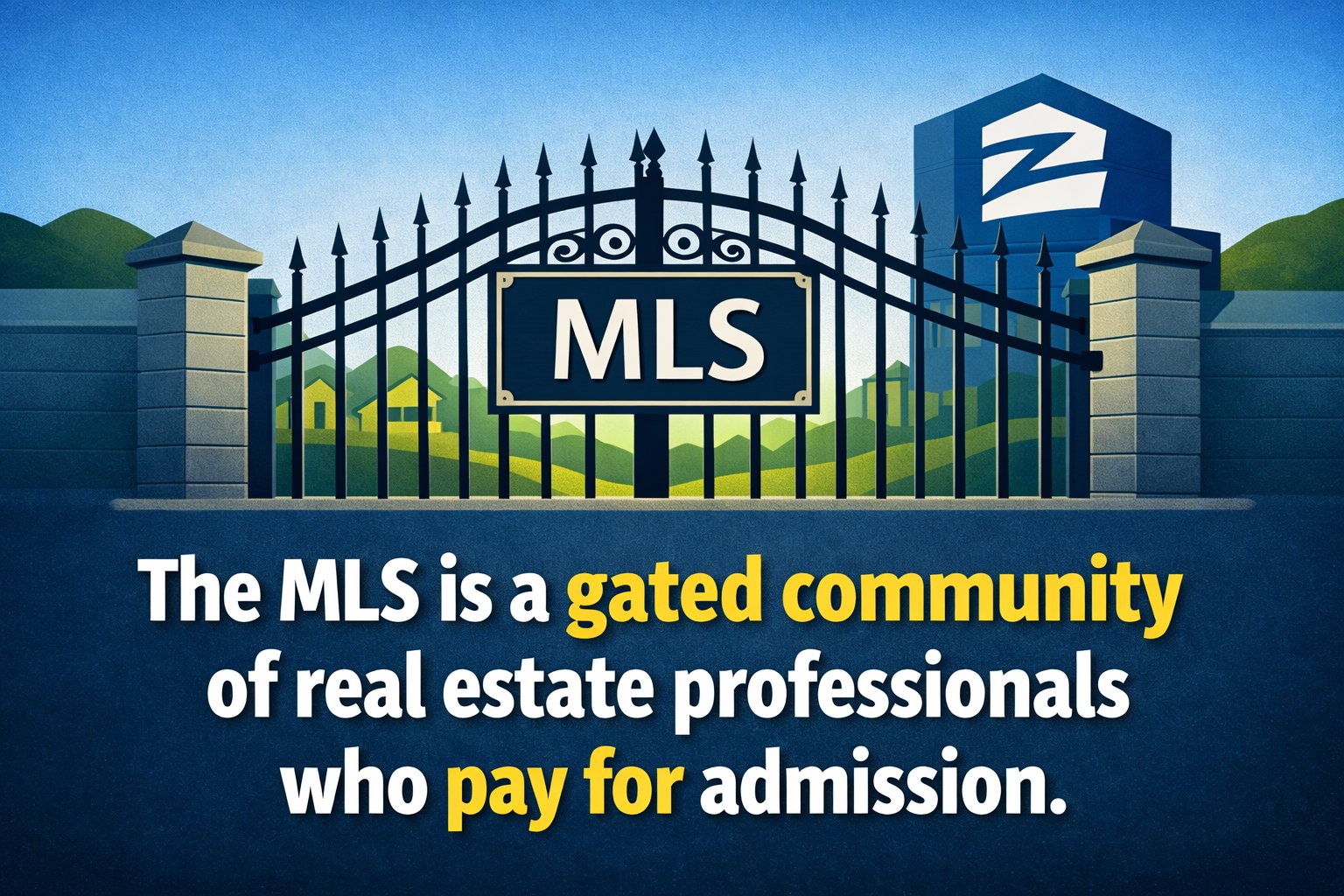
To access the MLS, a broker must pay fees, often hundreds of dollars per year. Not all licensed brokers and agents belong. Not all can afford to. Not all choose to. The MLS, by its very structure, is a gated community of real estate professionals who pay for admission.
So if anyone argues that SB 6091 requires MLS submission to satisfy the "all other brokers" requirement, they have created a logical impossibility. You cannot satisfy a mandate to reach all brokers by using a platform that excludes brokers who don't pay to belong. The math does not work. The logic does not work. And the law does not require it.
A broker who markets a home on a publicly accessible website and who simultaneously notifies the broader broker community through direct outreach, email, social media, and industry channels has arguably done more to reach "all other brokers" than the MLS ever could. Because the MLS charges admission. A public website does not.
Nobody Is Hiding Homes. They Are Marketing Them Better.
Let me address the elephant in the room. The narrative being pushed is that programs like Compass Private Exclusives or Howard Hanna's HannaList are somehow hiding homes from the public. That is simply false.
Compass Private Exclusives are visible to every consumer and every real estate agent in the country right on Compass's main website. Anybody with an internet connection can see them. No special access required. No secret handshake. Compass uses the word "Exclusives" for the same reason Ferrari uses "limited edition," Rolex uses "certified pre-owned," and Hermes uses "by invitation." It is intelligent marketing language designed to create a feeling of discovery and importance in the buyer. It makes you feel like you are among the first to know, like you are special, like you have inside access to something extraordinary.
That is not deception. That is not exclusion. That is world-class marketing.
Howard Hanna's HannaList operates similarly, giving sellers a strategic launch window while working within existing frameworks. Hoby Hanna himself has said the goal is to give sellers choice, not to hide listings.
Every sophisticated marketer in every industry on earth understands this principle. Even bread companies, among the most generic products you can imagine, design packaging and shelf positioning to make their particular loaf feel unique, exclusive, designed for a certain kind of buyer. Whether you are marketing to the healthy, the wealthy, or the wise, the principle is the same. You position your product to make the buyer feel like it was made for them.
Ferrari does not list its cars on every auto trading website. Hermes does not sell Birkin bags on Amazon. Rolex does not run clearance ads in the Sunday circular. These are the most valuable brands on earth, and they all practice strategic marketing that targets specific demographics. Not because they want to exclude buyers, but because they understand that when a buyer feels like they are discovering something special, they pay more, act faster, and value the purchase more deeply.
Now apply this to a $900,000 home in Seattle or a $1.5 million property in Bellevue. The homeowner who paid for that home, who maintained it, who raised a family in it, deserves the right to market it in a way that maximizes its value. If a broker can create an experience where qualified buyers feel like they are discovering something remarkable before the rest of the world catches on, that home will sell for more money. That is not theory. That is supported by decades of luxury marketing research showing that emotional connection drives 70% of consumer loyalty and purchase decisions in premium markets.
And this does not just apply to luxury properties. The owner of a $425,000 starter home in Tacoma deserves the same right to strategic marketing that protects their equity and maximizes their return.
The MLS does not create that experience. The MLS strips every home of its story and reduces it to a data row: square footage, bedroom count, lot size, days on market. It is a commodity platform that turns every home into a can of beans on a warehouse shelf.
What the MLS and Zillow Actually Do to Homeowners
If legislators genuinely cared about protecting consumers, they would be looking very hard at what happens to homeowners once their property enters the MLS and portal ecosystem.
The MLS creates a permanent, public record of every price reduction and every day a home sits unsold. That history follows the home like a scarlet letter and systematically destroys its perceived value. A seller who strategically adjusts their price based on market feedback is punished by a system that broadcasts every adjustment to the world as evidence of weakness.
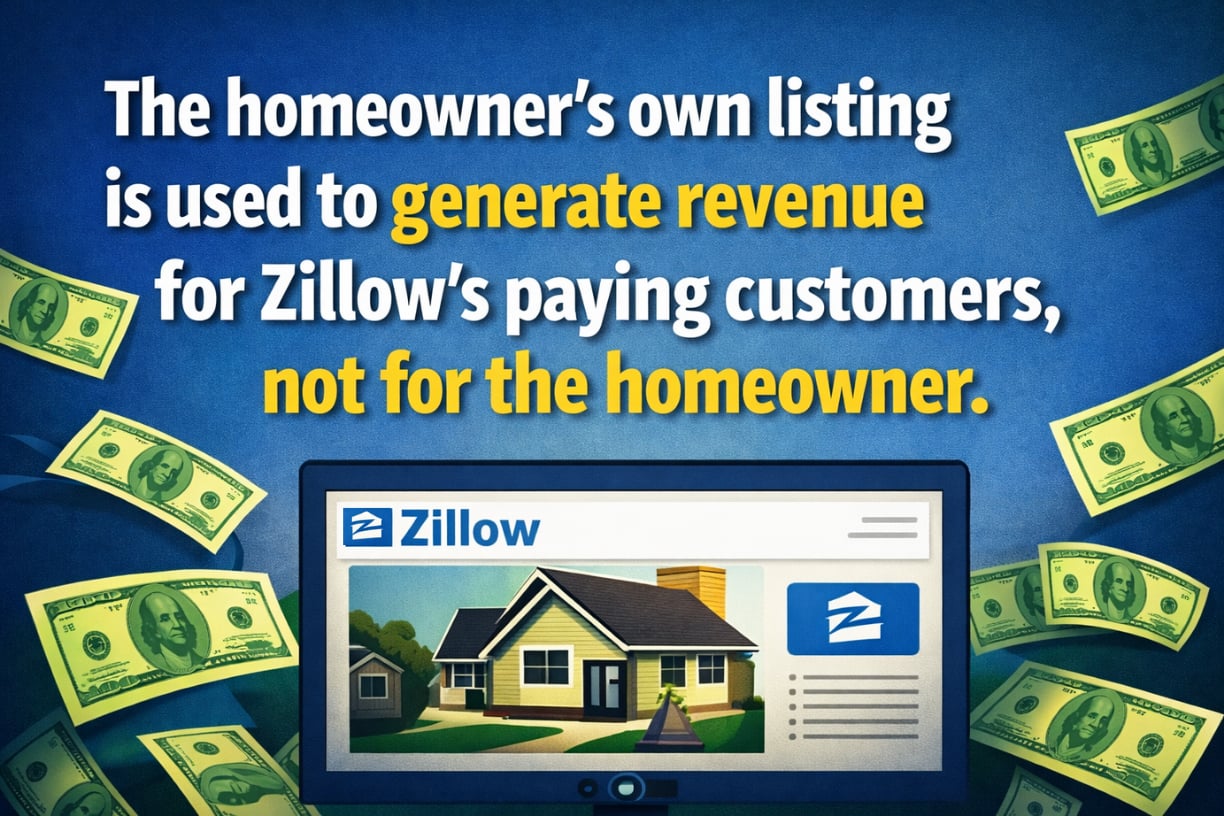
Zillow is worse. Not only does it display the same damaging data, but it actively diverts buyers who are interested in a specific home away from the listing agent, the person who actually knows the property, and sells those buyers as leads to other agents who pay Zillow referral fees. The homeowner's own listing is used to generate revenue for Zillow's paying customers, not for the homeowner. That is not transparency. That is exploitation.
And if buyers were knowledgeable enough about industry practices to actually complain, they would be screaming about Zillow's "Offer Guides" that post a probability that your lower-than-list-price offer will be accepted. That probability is nothing more than algorithmic guesswork dressed up to look like market intelligence. It misleads buyers into thinking they have data-driven guidance when they have nothing of the sort.
This is the real discrimination at work: a law that forces homeowners to use platforms that damage their property values while enriching corporate gatekeepers. The gatekeepers call programs like Compass Private Exclusives 'discriminatory,' but what could be more discriminatory than forcing every seller in Washington to subsidize Zillow's lead-generation business?
If anything deserves to be legislated, it is the predatory lead-diversion model and misleading consumer tools that cost both buyers and sellers real money through propped-up fees and injected incompetence. Not the opposite. Not forcing homes onto the very platforms that profit from exploiting them.
The Constitution Has a Problem with This. And So Should You.
Beyond the policy arguments, SB 6091 faces a serious constitutional challenge that any court would have to take seriously.
The First Amendment protects commercial speech, including advertising. The Supreme Court's Central Hudson test requires that any government restriction on truthful, non-misleading commercial speech must serve a substantial government interest, must directly advance that interest, and must be no more extensive than necessary.
SB 6091 fails this test at multiple levels. Marketing a home for sale is entirely lawful and truthful speech that qualifies for full First Amendment protection. Non-discrimination 'fair housing' laws that protect previously discriminated-against classes based on race, religion, sex, and age are morally justified and already legally upheld by the Supreme Court. But the Washington law does not target this kind of discriminatory marketing. It restricts all selective marketing regardless of intent or effect.
A broker marketing a luxury waterfront home through a curated channel is not discriminating against any protected class. They are doing what every premium brand does.
Think of it this way: imagine the government telling Nike it could only advertise shoes on government-approved websites. That is essentially what an aggressive interpretation of this law would do to real estate brokers.
The Washington legislature could have simply strengthened anti-discrimination enforcement instead. In my opinion, SB 6091 is overly broad and possibly unconstitutional because it imposed a blanket prohibition on how all brokers in the state market all residential properties. The Supreme Court has struck down exactly this kind of overbroad commercial speech restriction before.
No other product in America, no matter how essential, has ever been subjected to a government mandate dictating which channels must be used for truthful advertising. Not food. Not medicine. Not automobiles. Not healthcare. Housing would be the first. That alone should give every court pause.
What Compliance Actually Looks Like
Despite all of this, the law exists. So let's talk about compliance.
A broker who markets a home on any publicly accessible website satisfies the "general public" requirement. If that broker also proactively notifies the local broker community through direct outreach, email blasts, social media, and industry channels, they satisfy the "all other brokers" requirement. There is no MLS mandate. There is no Zillow mandate. There is no requirement to use any specific platform.
And here is an important point about websites that require a free registration to view listings. A free sign-in requirement does not make a website "limited or exclusive." Anyone can register. There is no fee. There is no qualification. There is no approval process. It is no different than creating a free account to read The New York Times online.
A broker operating a website that requires a simple email registration has arguably complied with both the letter and spirit of this law far more so than MLS systems that charge brokers hundreds of dollars for access.
More importantly, when a seller allows interior photos of their home to be published online, they are exposing their personal possessions, art, valuables, family layout, and security vulnerabilities to the world. Knowing who is viewing that information is not exclusion. It is intelligent and responsible homeowner protection. The bill itself contains a health-and-safety exception. A free registration requirement fits comfortably within both the letter and spirit of that exception.

The Real Fight Ahead
Any attempt to enforce SB 6091 as a mandate to use the MLS or any particular website should be challenged in court. Based on the text of the statute, the deliberate omission of any MLS requirement, the constitutional protections for commercial speech, and the complete absence of any comparable regulation for any other product in American commerce, such enforcement would very likely be defeated.
The real estate industry is at a crossroads. On one side are the gatekeepers, the platforms and organizations that have built enormous wealth by controlling the flow of listing information and selling access to the consumers that information attracts.
On the other side are homeowners and the brokers who actually represent them, people who believe that the owner of a home should have the right to market that home in the way that best serves their financial interests and personal security.
A person's home is likely the most valuable thing they own. They paid for it. They cared for it. They should have every right to market it in a way that maximizes its value, protects their privacy, and treats their property like the unique, significant asset it is. Not like a commodity to be processed through someone else's profit machine.
While SB 6091 is misguided, it does not take that right away. Read the text. It simply requires public marketing and broker awareness. How you accomplish that is your choice. And anyone who tells you otherwise is not protecting the public. They are protecting their revenue.
If you are a homeowner, ask your broker how they plan to market your home. If you are a broker, educate yourself on what this law actually requires, not what the gatekeepers want you to believe it requires. And if you are an industry observer, share this analysis widely. The more people who understand what is really happening here, the harder it becomes for corporate interests to hijack consumer protection language to serve their bottom line.
This is not just about Washington. Similar bills are being introduced in Wisconsin, Illinois, Hawaii, and Connecticut. The battle over who controls how American homes are marketed is just beginning. Make sure you are on the side that actually serves homeowners and protects their property rights—not the side of corporations that profit by controlling them.
——————————————————————————————
The views expressed in this blog represent legal analysis and informed opinion regarding SB 6091 and should not be construed as formal legal advice. While I am an attorney, I am not your attorney. Consult a licensed Washington State attorney for guidance specific to your situation.
Greg Hague
72SOLD Founder/CEO