June 11th, 2026
On Monday, June 8th, two folding chairs at Madison Square Garden sold for a million dollars.
Not the building. Not the team. Two seats, side by side, Section VIP 10, Row AA, numbers 25 and 26, close enough to center court that you could hear the sneakers squeak.
Here’s the strange part. Those seats were never for sale. They’re the celebrity seats, the ones quietly handed out each game to the well-known, like Spike Lee, Timothée Chalamet and Tracy Morgan, the faces the cameras find during timeouts. The Knicks put them up for auction exactly once, for charity, and two New York firms, a white-shoe law office and a private equity shop, split the tab. So, the seats reserved for the most recognizable people in America went, in the end, to two people nobody will recognize. They simply had the money.
And the money, on this particular night, had lost its mind.
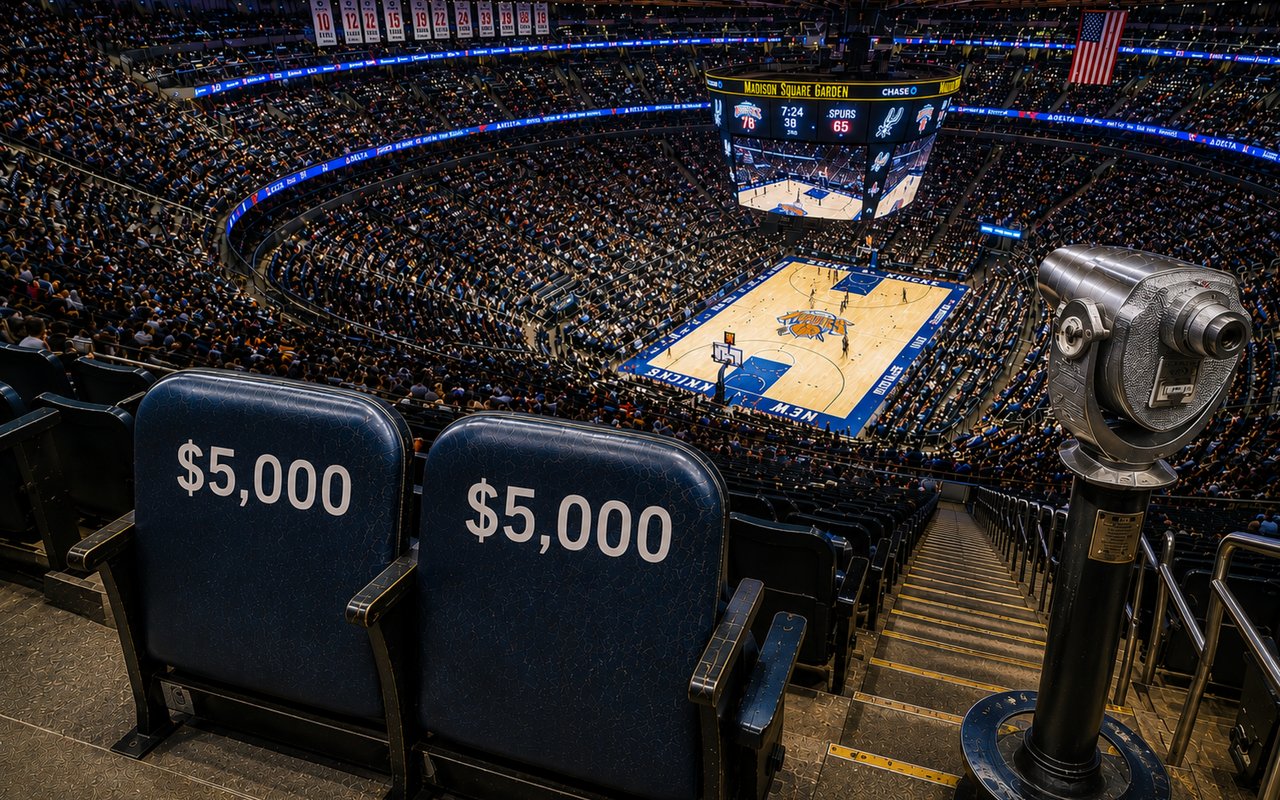
The cheapest ticket in the building, a nosebleed seat so high you’d need a telescope, was running about $5,000. The average seat went for around $8,000. One courtside seat, sold the ordinary way with no charity attached, was listed for more than $300,000. For one chair. For about two and a half hours of basketball.
This is not the first time crowds have done arithmetic like this.
When Floyd Mayweather fought Manny Pacquiao in 2015, the tickets alone brought in $72 million, the richest gate in the history of the sport. Super Bowl seats have crossed $50,000 apiece. And in 2016, when the Chicago Cubs reached Game 7 of the World Series with a 108-year championship drought hanging over them, a single pair of tickets was listed for over $1 million. People weren’t buying a ballgame. They were buying the chance to say they’d been there when the curse finally broke.
A ticket isn’t expensive because of where it puts you. It’s expensive because of who can’t sit there with you.
Which brings us to the only thing that was ever really for sale that night.
Madison Square Garden holds fewer than twenty thousand people for basketball. The Knicks were chasing their first title since 1973, and what felt like the entire city, plus a few million people beyond it, wanted to be inside that room. The arena could not grow. The want could. That gap, between the number of seats and the number of people who’d have sold a kidney to fill one, is the whole story. It is the only reason a folding chair costs more than a house.
Economists have a cold word for this. Scarcity. But there are two kinds, and the difference matters in business and everyday life.
The Garden’s scarcity is real. Intrinsic, we might call it. There are only so many seats, and no amount of money prints more, the same way there is exactly one Mona Lisa hanging in the Louvre and there will never, ever be two. We can want it all we like. The world made only one.
That’s the honest kind of scarcity, the kind nobody arranged.
But here is the part I find more interesting. Most of the scarcity we pay a premium for every day was not handed to us by the world. It was built. Manufactured. Arranged, quietly and deliberately, by someone who understood that wanting a thing often has very little to do with the thing itself, and everything to do with how hard it is to get.
And to see that quieter trick at work, look back at the two chairs we started with. The Garden’s walls are real scarcity. Celebrity Row is not. No law of physics decided that one row should belong to the famous. The Knicks decided it, named it, filled it with faces we’d recognize, and in doing so made seats 25 and 26 worth more than any beam or brick in the building. The walls were intrinsic. The row was invented.
That trick is older than basketball, and far more useful. Next week, how to turn the common into the coveted.
For now, just reflect on the number. A million dollars. Two chairs. And a building that simply ran out of room.