January 8th, 2026
The sale almost died in the first 60 seconds.
The seller, a quietly wealthy widow, folded her arms and said, "I've heard every real estate pitch in this city." Instead of defending his process, the agent said nine words that changed everything: "Then you've never heard how to make buyers compete."
She frowned, but her arms loosened. "Compete how?" she asked.
The agent smiled. "Let me show you the one thing traditional agents almost never do. If they did, their listings would start selling above asking instead of below."
Coffee went untouched. The meeting stretched from ten minutes to an hour. She signed. Weeks later, her home sold in three days at a price that her neighbors thought was a typo.
That's a real estate example, but the principle I'm about to share – the "information gap" – works in any business.
The Itch That Sells
That opening line did something most salespeople skip. It didn't inform. It irritated. It created an irresistible itch in the seller's mind: "What am I missing?"
That itch has a name. Behavioral economist George Loewenstein calls it an "information gap," a space between what someone knows and what they suddenly believe they need to know. His research shows that when people sense this gap, they feel a kind of mental tension that pushes them to close it. The brain treats unanswered questions like unfinished tasks. It wants resolution.
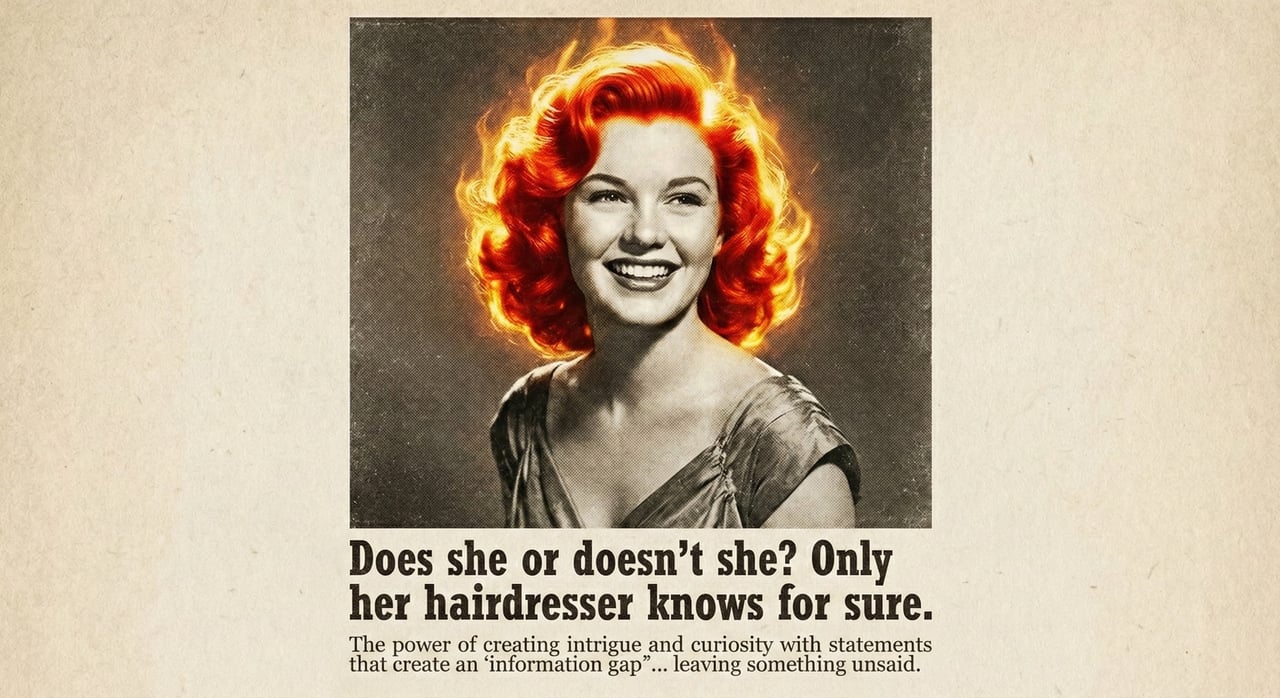
In 1993, Clairol's famous slogan demonstrated this principle perfectly: "Does she… or doesn't she? Only her hairdresser knows for sure." Sales of Clairol hair dye exploded from $25 million to $200 million a year. The ad never said the product was better. It simply opened a question that made people lean in.
Why Most Marketing Falls Flat
Most advertising announces. "Best prices!" "Top-rated!" "Family-owned since 1987!" These phrases wash over us like wallpaper because they answer questions nobody asked.
The brain ignores information it didn't request. But when someone hints that you're missing something relevant, something that could change a decision you're about to make, your brain treats it differently. Suddenly, you're paying attention.
Consider the difference:
"We get higher prices" versus "There's a simple change that often moves homes from price cuts to bidding wars."
"We follow a 7-step process" versus "There are two steps in our process that most agents don't know, yet they drive most of the extra money."
The second versions work because they signal a specific, valuable insight just out of reach. The brain hates loose ends, especially when money, status, or safety are involved.
The Curiosity Calibration
Here's where most marketers and salespeople go wrong: they close the gap too quickly or open it too wide.
Close it too quickly, and there's no reason to keep reading. "Our secret is hard work!" That's not a gap. That's a letdown.
Open it too wide, and people feel manipulated. "The one weird trick doctors don't want you to know!" We've all clicked those headlines and felt cheated.
The goal is to open the gap just enough that people lean forward, but not so wide that they roll their eyes and click away. Done well, curiosity turns a cold audience into an attentive one before you explain a single feature, benefit, or price.
Next week, I'll show you exactly how to create these gaps in your own marketing, whether you're writing ads, emails, presentations, or even having a conversation.
You'll learn the specific phrases that open loops, the questions that make prospects sell themselves, and the one technique that turns any ending into a reason to come back.
The agent who won the widow's listing? He didn't have a better pitch. He had a better itch.